
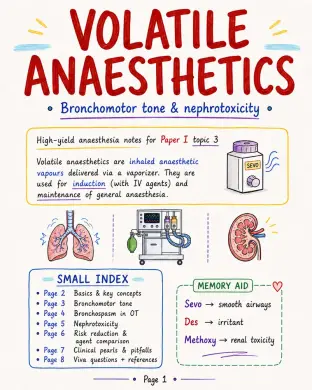
Volatile Anaesthetics
Image 1: High-yield anaesthesia notes for Paper I topic 3 - Volatile anaesthetics are inhaled anaesthetic vapours delivered via a vaporizer. They are used for induction (with IV agents) and maintenance of general anaesthesia. SMALL INDEX: - Page 2: Basics & key concepts - Page 3: Bronchomotor tone - Page 4: Bronchospasm in OT - Page 5: Nephrotoxicity - Page 6: Risk reduction & agent comparison - Page 7: Clinical pearls & pitfalls - Page 8: Viva questions + references MEMORY AID: - Sevo → smooth airways - Des → irritant - Methoxy → renal toxicity Image 2: Examples: - Sevoflurane - Isoflurane - Desflurane - Halothane - Enflurane - Methoxyflurane (historical) - Nitrous oxide (N2O) Mechanism: - Enhance inhibitory transmission (especially GABA-A / glycine) - Reduce excitatory transmission (NMDA and nicotinic pathways) - Alter ion channels (e.g. K+, Ca2+, Na+ channels) - Depress CNS in a dose-dependent manner MAC: - MAC = alveolar concentration preventing movement in 50% of patients to surgical skin incision - Low MAC = high potency - ~ 1.3 MAC prevents movement in ~ 95% - MAC decreases with: ↑ age, pregnancy, opioids, sedatives, hypothermia Agent Properties: - Sevoflurane: - Approx MAC (%): ~ 2.0 - Blood:gas coefficient: 0.65 - Airway note: Smooth, non-pungent - Isoflurane: - Approx MAC (%): ~ 1.15 - Blood:gas coefficient: 1.4 - Airway note: Pungent but bronchodilator - Desflurane: - Approx MAC (%): ~ 6.0 - Blood:gas coefficient: 0.42 - Airway note: Fastest, pungent, airway irritant - N2O (nitrous oxide): - Approx MAC (%): 104 - Blood:gas coefficient: 0.47 - Airway note: Weak, adjunct Exam Pearl and Memory Aid: - Potency is described by MAC - Speed is described by blood:gas solubility - Lower MAC = more potent - Lower blood:gas = faster induction & recovery - POTENT = LOW MAC - FAST = LOW BLOOD:GAS - Think: "Low numbers, low solubility → GO FAST!" Image 3: Mechanisms: - Direct airway smooth muscle relaxation - Reduced intracellular Ca2+ availability - Reduced myofilament Ca2+ sensitivity - K+ channel effects / hyperpolarisation - Reduced vagal reflex bronchoconstriction Agent differences: - Sevoflurane = least pungent, smooth inhalational induction, preferred in reactive airways - Isoflurane = bronchodilator but pungent - Desflurane = pungent, may provoke cough, breath-holding, laryngospasm, increased airway resistance when concentration rises rapidly Use in asthma/COPD: - Use adequate anaesthetic depth - Use humidified gases - Consider bronchodilator adjuncts (e.g. β2-agonists, anticholinergics) Exam Pearl: - Drug property alone is not enough - inadequate anaesthetic depth during airway manipulation can still cause bronchospasm. Image 4: Recognition: - Increased peak airway pressure - Wheeze or silent chest - Difficulty bagging - Prolonged expiration - Desaturation - Shark-fin capnogram Differential / exclude first: - Tube kink or obstruction - Secretions - Endobronchial intubation - Light anaesthesia - Anaphylaxis - Pneumothorax Management - stepwise approach: - 100% O2 and CALL HELP - Hand-ventilate and assess resistance - Deepen anaesthesia with sevoflurane or isoflurane or propofol - Salbutamol via circuit (MDI 4-8 puffs or nebuliser) - Add Ipratropium via circuit (MDI 4 puffs or nebuliser) - Steroids (e.g. Hydrocortisone 100 mg IV) - Magnesium sulfate (e.g. 2 g IV over 10-20 min) - Adrenaline if severe or anaphylaxis (e.g. 10-50 mcg IV bolus, repeat PRN) - Ventilate with LOW RR and LONG EXPIRATORY TIME to avoid air trapping Exam Pearl: - Ketamine can be helpful because it supports bronchodilation. Memory Aid: - Shark-fin capnogram = bronchospasm until proven otherwise. Image 5: Nephrotoxicity: - Volatile-related renal toxicity is classically associated with methoxyflurane. - Sevoflurane has a much smaller and more controversial renal concern. Methoxyflurane: - Extensive metabolism - High inorganic fluoride production - Dose-related polyuric renal failure / nephrogenic diabetes insipidus - Now obsolete for routine general anaesthesia Sevoflurane: - Metabolism produces fluoride - Degradation by CO2 absorbent can form Compound A - Risk rises with low-flow anaesthesia, dry absorbent, heat and high concentration - Clinically significant nephrotoxicity in routine humans is not consistently proven Pathway to renal risk: - Volatile agent → Metabolism / absorbent interaction → Fluoride or Compound A → Renal tubule exposure → Renal risk Metabolism (relative amount): - Methoxyflurane: VERY HIGH - Sevoflurane: LOW - Isoflurane: VERY LOW - Desflurane: MINIMAL Exam Pearl: - Classic answer = methoxyflurane; modern discussion = sevoflurane + Compound A Image 6: RISK FACTORS: - CKD (chronic kidney disease) - Elderly age - Dehydration / hypovolaemia - Hypotension / low MAP - Sepsis / systemic inflammation - Concomitant nephrotoxins (e.g. NSAIDs, aminoglycosides, radiocontrast) - Diabetes mellitus - Major surgery / prolonged duration - Poor renal reserve PREVENTION & BEST PRACTICE: - Maintain MAP and renal perfusion (MAP ≥ 65 mmHg unless otherwise indicated) - Avoid prolonged hypotension - Maintain euvolaemia (avoid both hypo- and hypervolaemia) - Avoid desiccated CO2 absorbent - Follow low-flow anaesthesia (use manufacturer recommendations) - Monitor urine output and creatinine in high-risk patients Agent Properties: - Sevoflurane: - Airway effect: Bronchodilator, non-pungent - Renal note: Compound A concern but usually safe clinically - Typical practical use: Inhalational induction, reactive airways - Isoflurane: - Airway effect: Bronchodilator but pungent - Renal note: Minimal renal concern - Typical practical use: Economical maintenance - Desflurane: - Airway effect: Airway irritant - Renal note: Minimal metabolism - Typical practical use: Rapid emergence, short procedures - Methoxyflurane (historical): - Airway effect: Not used for routine GA - Renal note: Classic fluoride nephrotoxicity - Typical practical use: Historical agent (obsolete) EXAM PEARL: - Metabolism alone does not equal toxicity – context, dose, duration and patient reserve matter. REMEMBER: - Good perfusion + euvolemia + sensible technique = kidneys stay happy! Image 7: Asthma / COPD: - Prefer Sevoflurane (least airway irritation among volatiles). - Ensure adequate depth before instrumentation. - Continue bronchodilators (pre-op and intra-op). - Use long expiratory time to prevent air trapping and dynamic hyperinflation. Desflurane pitfall: - Avoid Desflurane for inhalational induction and in patients with active reactive airway disease. - It is very pungent and causes airway irritation → coughing, laryngospasm, bronchospasm. MH warning: - All potent volatile agents (sevoflurane, isoflurane, desflurane, halothane, enflurane) are MALIGNANT HYPERTHERMIA triggers. - Avoid in susceptible patients and use trigger-free anaesthesia (TIVA ± nitrous if appropriate). - Have dantrolene and MH protocol ready. Neuro / ICP: - Volatile agents reduce CMRO2 (dose-dependent) → neuroprotective. - BUT at higher doses they cause cerebral vasodilation → ↑ CBF and ↑ ICP, especially with hypercapnia. - Keep normocapnia (PaCO2 4-5 kPa / 35-45 mmHg) to avoid ↑ ICP. Obstetric note: - High concentrations of volatile agents can relax uterine smooth muscle. - This can increase risk of uterine atony and postpartum haemorrhage. - Use the lowest effective concentration and monitor uterine tone closely. Image 8: Section heading: - Define MAC: - Alveolar concentration preventing movement in 50% of patients to skin incision. - Low MAC = high potency. Section heading: - Why is sevoflurane preferred in reactive airways? - Least pungent - Smooth induction - Bronchodilator effect Section heading: - Why can desflurane worsen airway responses? - Pungency and rapid concentration rise can provoke cough, laryngospasm and increased airway resistance. Section heading: - Which volatile is classically nephrotoxic? - Methoxyflurane, because extensive metabolism produces inorganic fluoride. Section heading: - What is Compound A? - A sevoflurane degradation product formed with CO2 absorbents, especially under low-flow / dry absorbent conditions. Section heading: - How do you manage intraoperative bronchospasm? - 100% O2 - Deepen anaesthesia - Exclude mechanical causes - Bronchodilators (β2-agonists / anticholinergics) - Adjuncts (MgSO4, IV steroids) - Adrenaline if severe / refractory Section heading: - Which agents trigger malignant hyperthermia? - All potent volatile anaesthetics and suxamethonium.