
IV Induction Agents for Anaesthesia
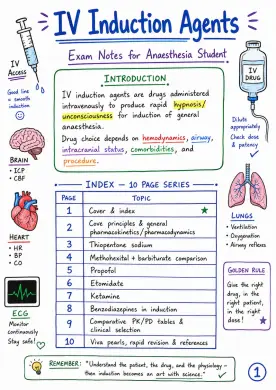
Image 1: INTRODUCTION: - IV induction agents are drugs administered intravenously to produce rapid hypnosis/unconsciousness for induction of general anaesthesia. - Drug choice depends on hemodynamics, airway, intracranial status, comorbidities, and procedure. HEART: - HR - BP - CO BRAIN: - ICP - CBF ECG: - Monitor continuously - Stay safe! LUNGS: - Ventilation - Oxygenation - Airway reflexes GOLDEN RULE: - Give the right drug, in the right patient, in the right dose! INDEX - 10 PAGE SERIES: - Page 1: Cover & index - Page 2: Cove principles & general pharmacokinetics/pharmacodynamics - Page 3: Thiopentone sodium - Page 4: Methohexital + barbiturate comparison - Page 5: Propofol - Page 6: Etomidate - Page 7: Ketamine - Page 8: Benzodiazepines in induction - Page 9: Comparative PK/PD tables & clinical selection - Page 10: Viva pearls, rapid revision & references Image 2: Definition: - IV induction agents are drugs given intravenously to produce a rapid, controlled, and reversible loss of consciousness (general anesthesia) to allow airway control and surgical stimulation. Goals of Induction: - Achieve UNCONSCIOUSNESS quickly - Produce AMNESIA - Suppress AIRWAY REFLEXES (facilitate intubation) - Maintain HEMODYNAMIC STABILITY - Rapid ONSET - Predictable RECOVERY Arm-Brain Circulation Time: - Time from injection in arm vein to arrival in the brain (first pass) = 10–20 seconds in adults. Factors Affecting Onset (time to loss of consciousness): - Cerebral blood flow ↑ = faster onset - Lipid solubility ↑ = faster onset (↑ BBB penetration) - Ionization / pKa ↓ non-ionized form crosses BBB faster (lower pKa at physiologic pH = faster) - Protein binding ↑ = slower onset (less free drug) - Dose (mg/kg) ↑ = faster onset - Cardiac output ↑ = faster onset (↑ delivery to brain) Why Short Duration After A Bolus?: - After a single bolus, the drug leaves the blood and redistributes from vessel-rich organs (brain, heart, liver, kidney) to muscle and fat. - This redistribution lowers plasma concentration rapidly and explains the short duration of action. - Metabolism and excretion occur, but are NOT the main reason for the rapid offset after a bolus. Classification of IV Induction Agents: - CLASS (CHEMISTRY): - Barbiturates: Thiopentone (Thiopental) (short-acting), Methohexital (very short-acting, largely obsolete now) - Alkylphenol: Propofol (most commonly used, rapid onset, short duration) - Imidazole: Etomidate (hemodynamic stability, minimal CV depression) - Phencyclidine Derivative: Ketamine (dissociative anesthesia, analgesia, bronchodilation, ↑ HR, ↑ BP) - Benzodiazepine: Midazolam (anxiolysis, amnesia, slower onset except midazolam), Diazepam, Lorazepam (older, not ideal as sole induction agent) Ideal IV Induction Agent - Properties: - Rapid onset - Adequate depth of anesthesia - Amnesia - Minimal pain on injection - Minimal cardiovascular & respiratory depression - Stable hemodynamics - Short duration / rapid, predictable recovery - Minimal PONV - Minimal organ toxicity / safe - Inexpensive Typical IV Induction Sequence: - Pre-oxygenate 100% O2 3–5 min - Give IV Induction Agent - Assess loss of consciousness (eyelash reflex absent) - Give Neuromuscular Blocker - Maintain Anesthesia (inhalational / IV) - Confirm tube placement & Secure airway - Laryngoscopy & Intubation - Ventilate with Mask (if needed) 3 breaths Factors Influencing Choice of Induction Agent: - Patient factors: age, ASA status, comorbidities (CV, respiratory, hepatic, renal, endocrine), allergies - Hemodynamic status (stable vs unstable) - Airway considerations (anticipated difficulty, aspiration risk) - Need for rapid sequence induction (RSI)? - Duration of surgery - Need for analgesia / special properties (e.g., bronchodilation) - Drug interactions / current medications - Availability and cost Image 3: Pharmacodynamics: - Barbiturate - Positive allosteric modulation of GABA-A receptor → increased duration of Cl- channel opening - At high dose, can directly activate GABA-A receptor - Produces CNS depression Dose: - 3-5 mg/kg IV Onset: - 20-30 sec Duration: - 5-10 min (due to redistribution) Effects: - CNS Effects: - Decreases CMRO2, CBF, ICP, IOP - Anticonvulsant - Cerebral protective effect - No analgesia - CVS Effects: - Venodilation and myocardial depression → decreased SV, CO → hypotension - Reflex tachycardia may occur - Respiratory Effects: - Respiratory depression - Apnea - Blunted CO2 response - May precipitate laryngospasm if airway stimulated in light anesthesia Pharmacokinetics: - Highly lipid soluble - Unionized fraction at physiologic pH allows rapid brain entry - pKa ≈ 7.6 - Protein binding ≈ 80% - Alkaline solution: pH ≈ 10-11 (increases stability) - Rapid redistribution from vessel-rich organs (brain, heart, liver) to muscle and fat → causes awakening Redistribution (Cause of Short Duration): - Immediately after IV: High concentration in vessel-rich organs - Later: Drug moves to muscle and fat (lower concentration) → Drug in brain → awakening Adverse Effects / Complications: - Extravasation injury: pain, cellulitis, necrosis - Intra-arterial injection: severe pain and ischemia, possible gangrene - Histamine release: uncommon (flushing, hypotension, bronchospasm) - Hiccups / coughing - Risk of precipitating acute attacks in porphyria Contraindications: - Hypersensitivity to thiopentone or barbiturates - Acute intermittent porphyria - Severe hepatic impairment - Shock or severe hypotension - Significant respiratory depression / obstruction - History of extravasation injury (use alternate agent) Uses: - Induction of general anesthesia - Control of status epilepticus (IV bolus) - Short-term control of raised intracranial pressure - Facilitation of endotracheal intubation - Sedation for short diagnostic / therapeutic procedures Not used for maintenance of anesthesia. High Yield Pearl: Thiopentone → Rapid onset, short duration (due to redistribution), ↓ ICP & CMRO2, good for neuroanesthesia. Use with caution in: elderly, hypovolemia, poor cardiac reserve. Image 4: **Methohexital - Pharmacodynamics** - Oxybarbiturate - GABA-A mediated CNS depression - Induction dose: 1 - 1.5 mg/kg IV - Very rapid onset - Ultra-short action - Faster recovery than thiopentone - More excitatory phenomena / involuntary movements - Lowers seizure threshold - Proconvulsant tendency - Useful in ECT - No analgesia - Respiratory depression and hypotension possible **Methohexital - Pharmacokinetics** - Very lipid soluble - Rapid brain uptake and redistribution - Hepatic metabolism - Less accumulation than thiopentone with single use, but repeated doses can still accumulate - Short clinical duration due to redistribution - Elimination half-life longer than apparent clinical effect **Feature Comparison** - **Class** - Thiopentone (Sodium Thiopental): Barbiturate (thiobarbiturate) - Methohexital (Brevital): Barbiturate (oxybarbiturate) - **Dose (IV)** - Thiopentone: 3 - 5 mg/kg - Methohexital: 1 - 1.5 mg/kg - **Onset (IV)** - Thiopentone: 20 - 30 seconds - Methohexital: 5 - 10 seconds (very rapid) - **Duration (Clinical)** - Thiopentone: 5 - 10 minutes - Methohexital: 2 - 5 minutes (ultra-short) - **pKa / Lipid Solubility** - Thiopentone: pKa ~ 7.6 | Less lipid soluble - Methohexital: pKa ~ 7.8 - 8.0 | More lipid soluble - **CNS Effect** - Thiopentone: Potent CNS depression - Methohexital: CNS depression (less deep, briefer) - **Seizure Effect** - Thiopentone: Raises seizure threshold (anticonvulsant) - Methohexital: Lowers seizure threshold (proconvulsant tendency) - **Recovery** - Thiopentone: Slower; can be prolonged with repeated doses - Methohexital: Faster recovery than thiopentone - **Clinical Use** - Thiopentone: General anesthesia induction (less used now) - Methohexital: Induction in ECT; short procedures when rapid recovery desired - **Porphyria Issue** - Thiopentone: Porphyrinogenic - avoid in AIP - Methohexital: Less porphyrinogenic - preferred in AIP - **ECT Preference** - Thiopentone: Not preferred (longer recovery, suppresses seizure longer) - Methohexital: Preferred agent for ECT **Exam Pearl** - Methohexital is preferred for ECT because it has an ultra-short duration, allows for rapid recovery between seizures, and does not accumulate significantly with single use. It also has a proconvulsant tendency which can help produce adequate seizures. - Thiopentone recovery becomes prolonged with repeated dosing because it accumulates in body tissues (lower lipid solubility, larger volume of distribution) and has slower redistribution and hepatic metabolism, leading to prolonged CNS depression. Image 5: PHARMACODYNAMICS: - Alkylphenol IV anesthetic. - Potentiates GABA-A receptor mediated inhibitory neurotransmission. - INDUCTION DOSE: - 1.5 - 2.5 mg/kg IV in healthy adults - Lower dose ~ 1 - 1.5 mg/kg IV in elderly, frail or hypovolemic patients. - ONSET: ~ 30 sec (IV bolus) - DURATION: ~ 5 - 10 min after bolus - No analgesia. - Marked fall in SVR, preload, and myocardial contractility → HYPOTENSION; possible BRADYCARDIA. - Profound respiratory depression / apnea and suppression of airway reflexes. - Relative bronchodilator. - Decreases CMRO2, CBF, ICP, IOP - Anticonvulsant. - Antiemetic. - Antipruritic. - Smooth, clear-headed recovery. PHARMACOKINETICS: - Formulated as a LIPID EMULSION containing soybean oil, glycerol, egg phosphatide/lecithin. - Highly LIPID SOLUBLE → rapid blood-brain equilibration → rapid onset. - High protein binding (~ 95-98%). - Large volume of distribution. - Rapid redistribution from brain to peripheral tissues → short duration. - High clearance with HEPATIC CONJUGATION (gl