
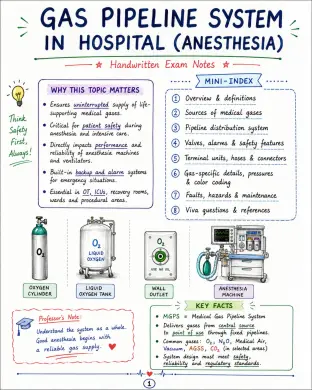
Gas Pipeline System in Hospital Anesthesia
- Ensures uninterrupted supply of life-supporting medical gases. - Critical for patient safety during anesthesia and intensive care. - Directly impacts performance and reliability of anesthesia machines and ventilators. - Built-in backup and alarm systems for emergency situations. - Essential in OT, ICUs, recovery rooms, wards and procedural areas. Mini-Index: - Overview & definitions - Sources of medical gases - Pipeline distribution system - Valves, alarms & safety features - Terminal units, hoses & connectors - Gas-specific details, pressures & color coding - Faults, hazards & maintenance - Viva questions & references Key Facts: - MGPS = Medical Gas Pipeline System - Delivers gases from central source to point of use through fixed pipelines. - Common gases: O2, N2O, Medical Air, Vacuum, AGSS, CO2 (in selected areas) - System design must meet safety, reliability and regulatory standards. Image 2: Definition: - MGPS (Medical Gas Pipeline System) = A centralized system that delivers medical gases from the source to the point of use through a network of pipelines. Objectives: - Safety of patients & staff - Continuity of supply - Purity of gases - Correct pressure at the outlet - Convenience in use - Economy in operation Where Used: - Operation Theatre (OT) - ICU - PACU (Recovery Room) - Emergency Department - Labor Room - Wards - NICU / PICU Common Services Carried: - O2 Oxygen - N2O Nitrous Oxide - AIR Medical Air - VAC Vacuum / Suction - AGSS Anaesthetic Gas Scavenging System - CO2 Carbon Dioxide (in selected areas) Flow of Gas in MGPS: - SOURCE: Bulk Tank / Cylinders - MANIFOLD / VIE / COMPRESSOR: Maintains continuous supply - REGULATORS: Reduces & stabilizes pressure - PIPELINES: Color coded distribution network - AREA VALVES: Zone control & isolation - TERMINAL UNITS: Point of use outlets - ANESTHESIA MACHINE / VENTILATOR: Delivers gas to the patient Why Anesthesia Depends on Interrupted Supply: - Anesthesia drugs and ventilatory support are life-sustaining. - Any interruption can lead to hypoxia, brain injury or death. Important Distinctions: - Pipeline Supply vs Cylinder Supply: - Pipeline = continuous, from central source. - Cylinder = limited quantity, needs changing. - Fixed System vs Portable Backup: - MGPS = fixed, built-in infrastructure. - Portable cylinders = used as backup during failure / maintenance. MGPS - Advantages & Limitations: Advantages: - Continuous & reliable supply - Multiple outlets to many areas - Reduced handling of cylinders - Improved safety & convenience Limitations: - High initial installation cost - Dependence on central supply - Requires regular maintenance & testing - Risk of cross-connection if poorly managed MGPS At A Glance: - CENTRAL PLANT (Source Room) - PIPELINE NETWORK - PATIENT CARE AREAS Image 3: OXYGEN SOURCES - Cylinder Manifold (High Pressure): - Working: High-pressure O2 cylinders (150-200 bar) connected in banks to a manifold with pressure reducing stages → pipeline. - Advantages: Simple, reliable, immediate availability, no power required, easy maintenance. - Backup: Two banks (duty & reserve) with automatic changeover; E-cylinder for transport. - Vacuum-Insulated Evaporator (Liquid Oxygen Tank): - Working: Liquid O2 (−183°C) stored in vacuum-insulated tank → vaporized in ambient vaporizer/evaporator → regulated & sent to pipeline. - Advantages: Large capacity, continuous supply, economical for high consumption, low manual handling. - Backup: Standby LOX tank or full cylinder manifold as reserve; level alarms & automatic switchover to backup. NITROUS OXIDE (N2O) MANIFOLD - Working: N2O cylinders manifolded similar to O2 with regulator → pipeline. - Advantages: Reliable, ready availability, easy refilling. - Backup: Reserve bank with auto changeover. MEDICAL AIR (COMPRESSED AIR) - Working: Ambient air compressed → dried → filtered → stored → regulated → pipeline (see flow below). - Advantages: On-site generation, unlimited source, essential for ventilators & surgical tools. - Backup: Duty & standby compressor with auto changeover; receiver storage for short outages. VACUUM PLANT (FOR SUCTION) - Working: Vacuum pumps create negative pressure → central vacuum pipeline for suction/aspiration. - Advantages: Continuous suction, supports multiple points. - Backup: Dual pumps (duty & standby) with auto changeover; vacuum receiver tank. AGSS DISPOSAL INTERFACE (Anaesthetic Gas Scavenging System) - Working: Waste anaesthetic gases → scavenging hoses → disposal system (active/passive) → safe vent/ destruction. - Advantages: Protects staff & environment from waste anaesthetic gases. - Backup: Regular maintenance; alarmed pressure monitoring for negative pressure integrity. CARBON DIOXIDE (CO2) CYLINDERS - Working: CO2 supplied in high-pressure cylinders → regulator → pipeline (used in laparoscopy, insufflation, pH monitoring, etc.). - Advantages: High purity, portable, accurate delivery. - Backup: Reserve bank with auto changeover. CYLINDER MANIFOLD vs LIQUID OXYGEN TANK - Parameter: - Capacity: Limited (size of bank) vs Very large (500–20,000 L) - Initial Cost: Lower vs Higher (tank + vaporizer) - Running Cost: Higher (frequent refills) vs Lower per unit (bulk supply) - Refill Frequency: Frequent (daily/weekly) vs Infrequent (weekly/monthly) - Manpower: More (cylinder handling) vs Less (automatic supply) - Space Requirement: More (bank area) vs Less (single tank) - Suitability: Low-moderate usage vs High usage (OT, ICU, large hospitals) - Pressure Handling: High (150–200 bar cylinders) vs Low delivery pressure (4–7 bar) - Dependence on Power: Nil vs Evaporator needs ambient air/electricity for control (minimal) - Backup Need: Reserve bank essential vs LOX tank + cylinder manifold as reserve SUPPLY HIERARCHY - PRIMARY SUPPLY: Normal source of supply for day-to-day use. Example: LOX bank/ duty cylinder bank/ duty compressor. Monitored 24×7. - SECONDARY / RESERVE SUPPLY: Takes over automatically when primary fails/empty. Example: Reserve cylinder bank / standby LOX tank/ standby compressor. - EMERGENCY RESERVE: For complete system failure or major disaster. Example: E-cylinders, portable suction, manual resuscitation backup. PURITY & CONTAMINATION CONTROL - CRUCIAL! - All medical gases must meet PHARMACOPEIAL STANDARDS (e.g., O2 ≥ 99.5%, N2O ≥ 99.0%, Air ISO 8573-1 Class 1.2.1). - Maintain oil-free, clean, dry systems; prevent moisture, oil, and microbial contamination. - Regular preventive maintenance, leak testing, and quality monitoring are essential for patient safety. Image 4: Components Explained: - Main Supply Line: Receives gas from source plant/manifold. - Branch Lines: Distribute gas to different areas or departments. - Risers: Vertical pipes that carry gas between floors. - Ring Main / Loop: Closed-loop piping around the building/floor to ensure uniform pressure and continuous supply. - Pressure Regulators: Maintain desired outlet pressure. - Shut-off Valves: Isolate sections for maintenance or emergency. - Line Pressure Gauges: Indicate pressure at key locations. - Line Pressure Sensors: Send pressure data to monitoring system. - Terminal Units: Deliver gas to the point of use (e.g., O2, VAC, AIR). Pipeline Materials (Medical Gas): - Seamless copper pipes are usually used for medical gas distribution. - Pipes are degreased and cleaned internally to remove oil, dust and foreign particles. - Joined by silver brazing for strong, leak-free joints. - Pipelines are labeled throughout with gas name and flow direction. - System is pressure tested, leak tested and cross-connection tested before commissioning. Zoning Concept: - Plant Room: House source equipment, manifolds and control panels. - Main Line: Carries gas throughout the building (ring main). - Floor / Department Branch: Branch lines supply each floor or department. - Operating Theatre Area: Gas delivered via terminal units & AVSU to OT. Typical OT Wall Outlets: - Each outlet gas-specific and non-interchangeable. - Color coding as per standard. Installation Requirements: - Proper identification of each gas. - Clear labeling at regular intervals. - No oil, grease or organic materials inside the pipeline. - Pressure testing before commissioning. - Leak testing at all joints & connections. - Cross-connection (continuity) testing to prevent gas mix-up. Area Valve Service Unit (AVSU): - Provides local control at point of use. - Includes isolation valves, pressure gauge, test point and outlet connection. - Located near clinical areas (e.g., outside OT, ICU, wards) for easy access and quick isolation. Ideal Features of Pipeline Network: - Safety: No leaks, no cross-connections, proper pressure control. - Reliability: Uninterrupted, stable supply with alarm & monitoring. - Accessibility: Outlets available where needed, easy to use for staff. - Maintainability: Sections can be isolated and serviced without disrupting entire system. - Non-interchangeability: Gas-specific components, color coding and DISS/NIST outlets prevent mix-ups. Image 5: KEY VALVES & DEVICES - Main Shut-off Valve – isolates entire pipeline system. - Line Regulators – reduce high pressure to safe working pressure. - Non-Return / Check Valves – prevent backflow & reverse contamination. - Pressure Relief Valve – releases excess pressure to protect system. - Emergency Isolation Valve (EIV) – rapid shut-off during major leak/fire or emergency. - AVSU (Automatic Valve Shut-off Unit) – detects pressure drop & automatically closes EIV. - Pressure Gauges – indicate line pressure for continuous monitoring. ALARM SYSTEMS - OVERVIEW - Alarm systems provide early warning of unsafe conditions. - They are essential for patient safety during anesthesia. - Alarms must be clearly audibl